Recology Artist in Residence
Body of Land, Body of Water, by Weston Teruya
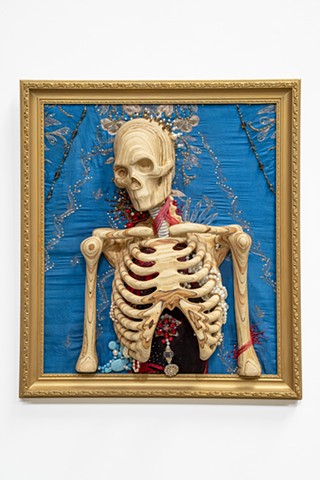
Across Laurel Roth Hope’s meticulously crafted series of sculptures, we see wooden, skeletal bodies caught in a state of indeterminacy, their internal systems laid open and vulnerable. They seem to be somewhere between summoning organs from our eternal consumer waste and slowly breaking apart, leaving behind the parts that stubbornly refuse to biodegrade back into the earth. The sculptures are seductive in their intricately crafted details: curving wood grain, beaded bursts of texture, wires laid in sinewy rows. The forms sink into the surfaces of the work, a plastic rope mat that suggests the span of an ultramarine ocean; a corporeal topography that roots the human figure within the landscape. As suggested through her title–Body of Land, Body of Water–these suggest an embodied cartography orienting us to our place in the environment and geologic time.
In past projects, Roth Hope has explored the impact humans have had on the rest of the natural world through sculptural forms using manufactured consumer goods to replicate animals and plants in painstaking detail. In this series, she turns that lens back on ourselves to explore the ways our industries, waste, and excesses impact us in turn. We are not separate from the ecosystem or our waste streams. The sculptural bodies in the exhibition have been stripped down, beneath individual identifiers and features, revealing a common human-ness that has become inextricable from the surrounding earth, even in its artificiality.
As plastics and chemicals leach into the environment to move through the food chain, slowly accumulating in our bodies, we must remember that our survival and well being has never been, and will never be, independent from the earth’s health as a whole. Our world demands reciprocity, yet so many of our values and systems reinforce practices of extractive consumption. By asking us to consider these skeletal bodies–their delicate interiors reminding us of our mortality even as they are remade with scavenged discards that will last long past any of our lifespans–we must stretch our sense of time and responsibility. How might our perspective shift if we truly understand ourselves within a larger ecosystem?